Best Fence for Seattle Weather
Cedar or vinyl for Seattle rain, moss, and gray winters? Compare King County picks and height rules. Book a free quote today.
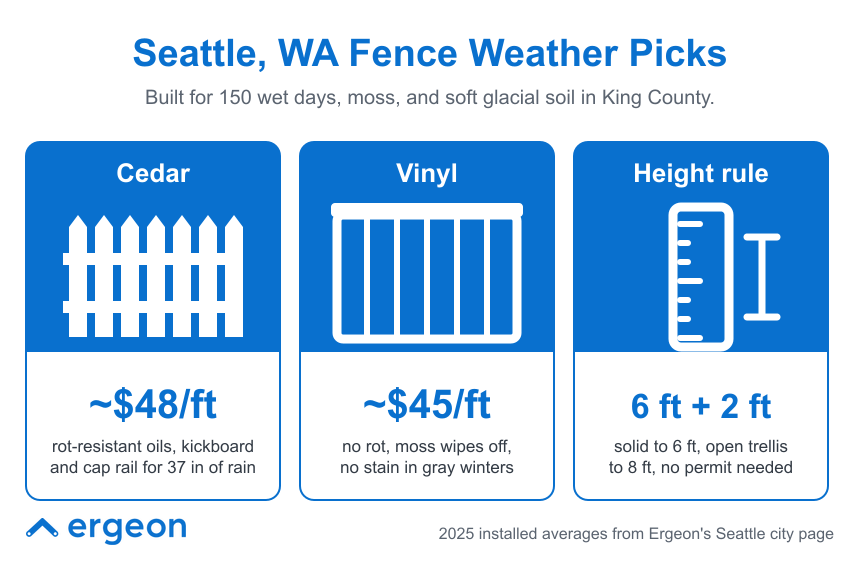
For most Seattle privacy yards facing about 37 inches of rain spread across roughly 150 wet days a year, moss and algae on every shaded surface, soft glacial soil, and a few Puget Sound windstorms each winter, cedar is the strongest everyday weather pick when you want the classic Pacific Northwest look and a wood that resists rot on its own. Ergeon's published Seattle rates put wood at about $48/ft and vinyl at about $45/ft installed (2025 averages), so vinyl is the rare case where the no-stain option also costs less per foot. Vinyl Solid Privacy wins when you never want to stain or scrub again, and an open picket or ranch rail run makes sense on wind-exposed lines above the Sound in Magnolia, West Seattle, and the bluff lots of Shoreline and Burien.
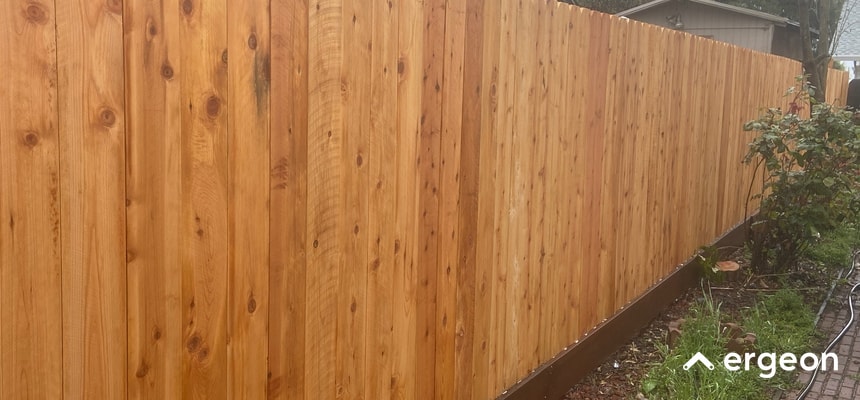
Cedar is usually the best everyday weather pick for Seattle when you want a natural wood privacy fence that shrugs off constant damp. Its natural oils resist rot and insects without pressure treatment, which is why Ergeon's Seattle packages lean on cedar pickets over pine. Vinyl is the low-maintenance alternative when you never want to stain again and would rather hose moss off than sand it. Picket and ranch rail profiles fit exposed bluffs and corner lots where winter wind matters more than a sealed privacy wall.
Seattle weather is a slow, wet problem rather than a violent one. Rain falls in drizzle from October through May, shade from evergreens and close-set houses keeps fence faces damp for weeks, and moss, algae, and mildew colonize any board that never dries. Freeze events are short and shallow, so frost heave is minor, but saturated glacial till and clay in Ballard, Rainier Valley, and much of the Eastside hold water around post bases. The occasional November or December windstorm brings 40 to 60 mph gusts off Puget Sound that test any solid 6 ft panel on an open lot. For how materials hold up over time, see Ergeon's what fence lasts longest guide. For a wood-versus-vinyl breakdown, see vinyl vs wood fence.
National cost context: wood fence costs and vinyl fence costs.
Rot at the ground line is the daily enemy of wood in Seattle. Pickets that touch soil or sit in splashing mulch wick water year-round, so ask for a pressure-treated kickboard under cedar pickets and keep beds and bark mulch an inch or two off the boards. A cap rail on a Decorative In Panel build sheds water off the picket end grain where checking and black staining start. Plan a water-repellent, mildew-resistant stain in the first dry summer and again every two to three years, and rinse moss off shaded north faces each spring. Ergeon's Value Flat Top uses prestained fir, which is the budget entry, but cedar is the better bet on the wettest, shadiest lines.
Posts matter as much as pickets. Set them in concrete with a gravel base so water drains away from the post foot, since saturated clay and till hold moisture against wood for months. Ergeon backs wood and steel posts for seven years on every Seattle project. Vinyl skips the rot question entirely: moss and algae film wipe off with a hose and mild soap, and UV-stabilized panels do not gray under the summer sun. Match material to the yard segment: keep cedar or vinyl privacy on rear and side runs, where Seattle allows 6 ft of solid fence plus up to 2 ft of open trellis or lattice to 8 ft total, and keep front and street-side setback fences at 4 ft. No permit is needed at or under 8 ft unless the lot sits in a flood-prone area, and sloped lots can average height along each 6 ft segment. On wind-exposed bluffs and corner lots, use picket, ranch rail, or a lattice-topped panel that lets gusts through. See Ergeon's guide to fence laws in Seattle, WA for the full height and boundary rules.
Decorative In Panel in cedar with a post reveal and post cap and Horizontal cedar with a vertical fascia fit rear privacy yards when you budget stain work, and both keep water off the picket tops better than a plain flat top. Value Flat Top in prestained fir is the lowest-cost wood entry for sheltered lines. Vinyl Solid Privacy and Privacy with Lattice fit when you want zero stain work through the gray season, and the lattice version uses the extra 2 ft of open height Seattle allows. Picket Fence, cedar Ranch Rail, and vinyl Ranch leave gaps for 4 ft front runs and wind-exposed lines, and Semi Privacy vinyl splits the difference on side yards that catch the breeze off the water.
Browse current options on the Seattle city fence page. Match package names, finished height, and gate count before you compare bids. Ergeon's King County coverage also includes Bellevue, Kirkland, Redmond, Renton, Kent, Federal Way, Issaquah, Sammamish, Bothell, Woodinville, and Mercer Island.
Start on the Seattle city fence page, or call 206-785-3432 / 1-888-374-3661, then lock cedar or vinyl on a live video quote. Draw your fence line on the satellite map, pick the material that matches your shade and wind exposure, and confirm gates, slope, and drainage before you schedule.
Ergeon has completed 71 projects in the Seattle area, and recent projects average about 6 weeks from quote approval to completion, so book early if you want the fence up before the fall rains. Recent jobs include $2,043 (N 46th St, wood), $1,704 (Gould Ave S, wood), $1,420 (3rd Ave NW, wood), and $4,493 (S Holden St, chain link). In clear conditions, crews install about 60 linear feet per day once work begins, so a 100-ft run is about one to two days on site. Concrete reaches full cure in about 30 days; avoid leaning on new posts during that window. Monthly financing is available on qualifying projects. Final price depends on length, height, material, and terrain. See how it works for the quote-to-install flow.
Most Seattle fences at or under 8 ft need no permit, but SDCI asks for a scaled site plan when a permit is required, which applies to fences over 8 ft, masonry over 6 ft, fences in flood-prone areas, and work near environmentally critical areas such as steep slopes. A certified survey often runs $1,000 to $3,000, and you usually do not need that level unless the city specifically asks for a stamped drawing. Ergeon can generate a permit-ready, GIS-based site plan in about 15 minutes for $29, using the same tool it relies on for its own permit filings.
What is the best fence for Seattle weather?
Cedar is usually the best everyday weather pick for constant damp when you want natural wood and a stain schedule. Vinyl is the stronger low-maintenance pick for moss and gray winters, and it costs slightly less per foot in Seattle. Picket or ranch rail styles fit wind-exposed bluff and corner lots.
Is vinyl better than wood in Seattle rain?
For upkeep, yes. Vinyl does not rot, moss rinses off, and it never needs staining. Cedar resists rot naturally and looks more at home in Northwest yards, but plan a kickboard, a cap rail, and a stain every two to three years.
How tall can a fence be in Seattle?
Up to 6 ft of solid fence in side and rear yards, plus up to 2 ft of open trellis or lattice for 8 ft total. Fences in front and street-side setbacks are limited to 4 ft. No permit is needed at or under 8 ft unless the fence has masonry over 6 ft or sits in a flood-prone area.
How much does a Seattle fence cost?
Ergeon's published Seattle averages are about $48/ft for wood and $45/ft for vinyl installed (2025). Recent local jobs ranged from about $1,420 to $4,493 depending on length, gates, and site conditions.
How long does a fence install take in Seattle?
Recent projects average about 6 weeks from quote approval to completion. In clear conditions, crews install about 60 linear feet per day once work begins.
Get a free quote in Seattle - Call 206-785-3432 or 1-888-374-3661. Monthly-payment financing is available on qualifying projects.
 Local Guides
 Local Guides
 Local Guides


