How Your Fence Can Be Tax Deductible
Unlock tax savings with your fence! Did you know your fence can be a tax deduction? Read more about how investing in a fence can save you money on your taxes!
It's tax season—and that means there's one thing on everyone's minds: potential deductions. Did you know that your new fence has the potential to save you money on your taxes?
For tax purposes, home improvement includes any work done that adds substantial value to your home, increases its usefulness or adapts it to new uses. Examples include room additions, new bathrooms, new roofs, plumbing upgrades and new fencing. All of these things have the potential to reduce your tax liability either through depreciation over time or by increasing your home's adjusted basis for a future sale. The exact benefit depends on how the property is used.
Here's a few tips to keep in mind when it comes to possible deductions from your new fence.
If you get a new fence installed at a home that is used purely as your primary residence, you won't be able to deduct the cost on your taxes for that same tax year. However, that doesn't mean you won't benefit from the investment.
By installing a new fence, you increase the "tax basis" of your property. Your tax basis includes the amount you've invested in your property over time. This means, if you were to sell that property, you'd be able to deduct the cost of your home improvements in order to lower the amount that you're subject to pay in taxes after the sale, as your total profit would be lower.
For example, say you bought your home for $300,000, paid $10,000 in closing costs, and then spent $50,000 on capital improvements including a new fence. Your adjusted basis is now $360,000. If you later sell the home for $400,000 and pay $25,000 in selling costs (agent commissions, fees, etc.), your net proceeds are $375,000. Your taxable gain would be $375,000 – $360,000 = $15,000.
That said, most homeowners won't owe anything on that gain. You may be able to exclude up to $250,000 of gain (single filers) or $500,000 (married filing jointly) when selling a primary residence as long as you owned and lived in the home for at least 2 of the last 5 years. For the majority of homeowners, this exclusion can eliminate capital gains tax entirely.
Increasing your basis through improvements like fencing generally becomes most relevant if:
For this reason, you can think of installing a new fence at your home as a long-term investment because it can help you save money down the line — particularly if your home has appreciated significantly.
*For more details, see: IRS Publication 523 — Selling Your Home; IRS Publication 551 — Basis of Assets*
For this reason, you can think of installing a new fence at your home as a long-term investment because it can help you save money down the line.
Related: Is a new deck tax deductible?

If you own a business, you're likely familiar with the rules for business expense deductions. Like other business expenses, your new fence needs to be ordinary and necessary to the business in order to classify as a legitimate deduction.
There are several reasons why a new fence would be necessary for your business, however. For example, an old fence that poses a safety hazard would need to be replaced for the sake of your business. A privacy fence may be necessary, depending on the nature of your business. A chain-link fence may be necessary to clearly mark your business property line and keep out intruders, etc.
A new fence on business property is generally classified as a land improvement and is typically capitalized and depreciated over 15 years using the MACRS (Modified Accelerated Cost Recovery System) method rather than being fully deducted in the year installed. Depending on when the fence was acquired and current legislation, bonus depreciation may allow you to deduct a significant portion or potentially even the full cost in the year it's placed in service. Section 179 expensing may also apply in some cases. These rules have changed recently, so it's important to check with a tax professional to determine what applies to your specific situation and timing.
*For more details, see: IRS Publication 946 — How to Depreciate Property*
Home improvements to your rental property can often count as a tax write-off. Similar to the rules for deductible home improvements to a business property, improvements made to your rental property would need to be necessary and ordinary to keep the property in good shape and liveable for tenants.
People who use a portion of their property or home as a rental can still deduct some of the expense. In this case, the homeowner can calculate the percentage of the home that is rented out and then use that percentage for the amount of home improvement expenses that would be deductible. As with business properties, a new fence on a rental property is generally treated as a land improvement — typically capitalized and depreciated over 15 years rather than deducted in full the year it's installed. Bonus depreciation or Section 179 expensing may allow for accelerated deductions depending on current rules and when the fence was acquired.
Important: only the improvement portion follows depreciation rules. If you're making a minor repair such as fixing a few broken boards, that expense may be deductible in the current year. The IRS uses the Betterment, Restoration, and Adaptation (BAR) test to distinguish repairs from improvements (see next section).
*For more details, see: [IRS Publication 527 — Residential Rental Property*
Many people ask "is replacing a fence tax deductible?" For tax purposes, it matters what type of work you're doing to your fence. The IRS differentiates between a repair and an improvement (or new fence). If you purchase a home with an existing fence in disrepair, you can't add the cost of fixing the fence to your tax basis. In this case, repairing it is considered regular maintenance of the home.
When it comes to repairing fence damage from the wind or one that had significant rotting, repairing these instances is not considered an improvement. However, if you replace an existing fence with a new fence that is different, this constitutes an improvement. You may need a full replacement due to damage or due to use case (for example, if you need to build your fence to a new fence height for privacy.)
For rental and business properties the distinction matters even more. The IRS applies the Betterment, Restoration, and Adaptation (BAR) test to determine whether work is a deductible repair or a capitalizable improvement:
If yes to any, it's generally an improvement (capitalize and depreciate). If no, it's likely a repair (may be deductible in the current year for rental/business property).
*For more details, see: Treasury Regulation §1.263(a)-3*
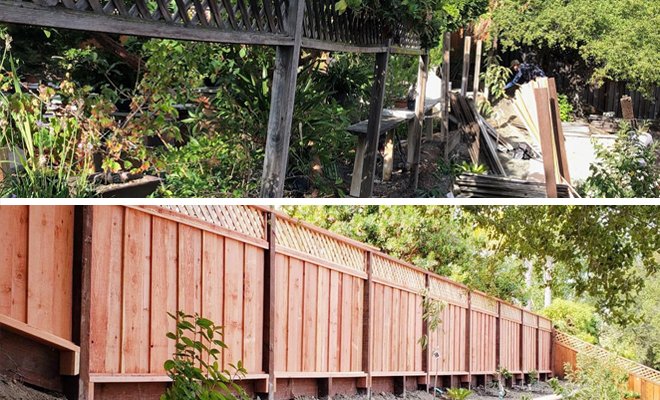
For rental or business property, the total cost of a fence both materials and paid labor is generally included in the depreciable cost of the improvement. For a primary residence, these costs increase your adjusted basis rather than being deducted directly. However, you can't deduct or include the cost of your own labor — which means if you choose to DIY your fence you could miss out on some of the tax savings. There are also several other reasons why DIY fence is a bad idea, so consider all factors before endeavoring to install a new fence yourself.
If you work from home and claim a home office deduction, a portion of your fence cost may need to be allocated to business use and depreciated accordingly. Be aware that any depreciation claimed may be subject to recapture tax when you sell the home.
*For more details, see: IRS Publication 587 — Business Use of Your Home*
Under current law, personal casualty losses from fence damage are generally only deductible if the damage occurs in a federally declared disaster area. Routine storm or wind damage to a fence at your primary residence is typically not deductible.
*For more details, see: IRS Publication 547 — Casualties, Disasters, and Thefts*
A quality fence is a wise investment for many reasons including potential long-term tax benefits. For primary residences, it increases your adjusted basis, which may reduce taxable gain if your profit exceeds the Section 121 exclusion. For rental and business properties, it's generally a depreciable asset that can provide tax savings over time, with accelerated expensing potentially available depending on current rules. Whether the benefits are seen immediately or further in the future, all of these considerations are good to keep in mind. Tax laws change frequently, so always consult with a qualified tax professional before making decisions based on potential tax savings. You can read more about tax deductions for home projects on the IRS website. Looking for more tax savings with your home improvement projects? Discover how your new driveway can be tax deductible.
*This article is for general informational purposes only and does not constitute tax, legal, or financial advice. Tax laws change frequently including recent changes to depreciation rules. Consult a qualified tax professional for guidance specific to your situation.*

 Fence Costs
 Fence Costs
 Fence Costs
%20(1).png)


