Gravel Driveway Calculator

Calculation results
- Area Covered (sf)
- 4,357
- Volume (cubic yards)
- 80.69
- Volume (cubic feet)
- 2,178.50
- Weight (tons)
- 103.36 - 114.24
- Weight (metric tons)
- 93.77 - 103.64
Gravel Driveway at a Glance
On this page
- Gravel Driveway at a Glance
- How much gravel do I need for a 2-car driveway?
- Step 1: Convert the dimensions to a consistent unit of measurement
- Step 2: Calculate the volume of the driveway
- Step 3: Calculate the cost of the gravel
- Summary and Example
- What type of gravel is best for a driveway?
- How much does it cost to install a gravel driveway?
- How often does a gravel driveway need maintenance?
- How long does a gravel driveway last?
- What are the pros and cons of having a gravel driveway?
How much gravel do I need for a 2-car driveway?
| Driveway size | Area | Cubic yards (6 in deep) | Tons (6 in deep) |
|---|---|---|---|
| 1-car (12 x 20 ft) | 240 sq ft | 4.4 | 5.7 - 6.3 |
| 2-car (20 x 20 ft) | 400 sq ft | 7.4 | 9.5 - 10.5 |
| Wide 2-car (24 x 24 ft) | 576 sq ft | 10.7 | 13.7 - 15.1 |
| Long 2-car (20 x 40 ft) | 800 sq ft | 14.8 | 19.0 - 21.0 |
Driveways are usually built up in two or three compacted layers totaling 6 inches or more, so treat 6 inches as a sensible default and adjust the depth in the calculator to match your plan. Trace your actual driveway on the map above for an exact figure. For landscaping beds, paths, or other materials such as sand, soil, rock, or riprap, use our general Gravel Calculator.
Step 1: Convert the dimensions to a consistent unit of measurement
The function begins by converting the width, length, and depth of the driveway to a consistent unit of measurement. The conversion rates used are as follows:- 1 inch (in) = 0.0277778 feet (ft)
- 1 foot (ft) = 1 foot (ft)
- 1 yard (yd) = 3 feet (ft)
- 1 centimeter (cm) = 0.0109361 feet (ft)
- 1 meter (m) = 3.28084 feet (ft)
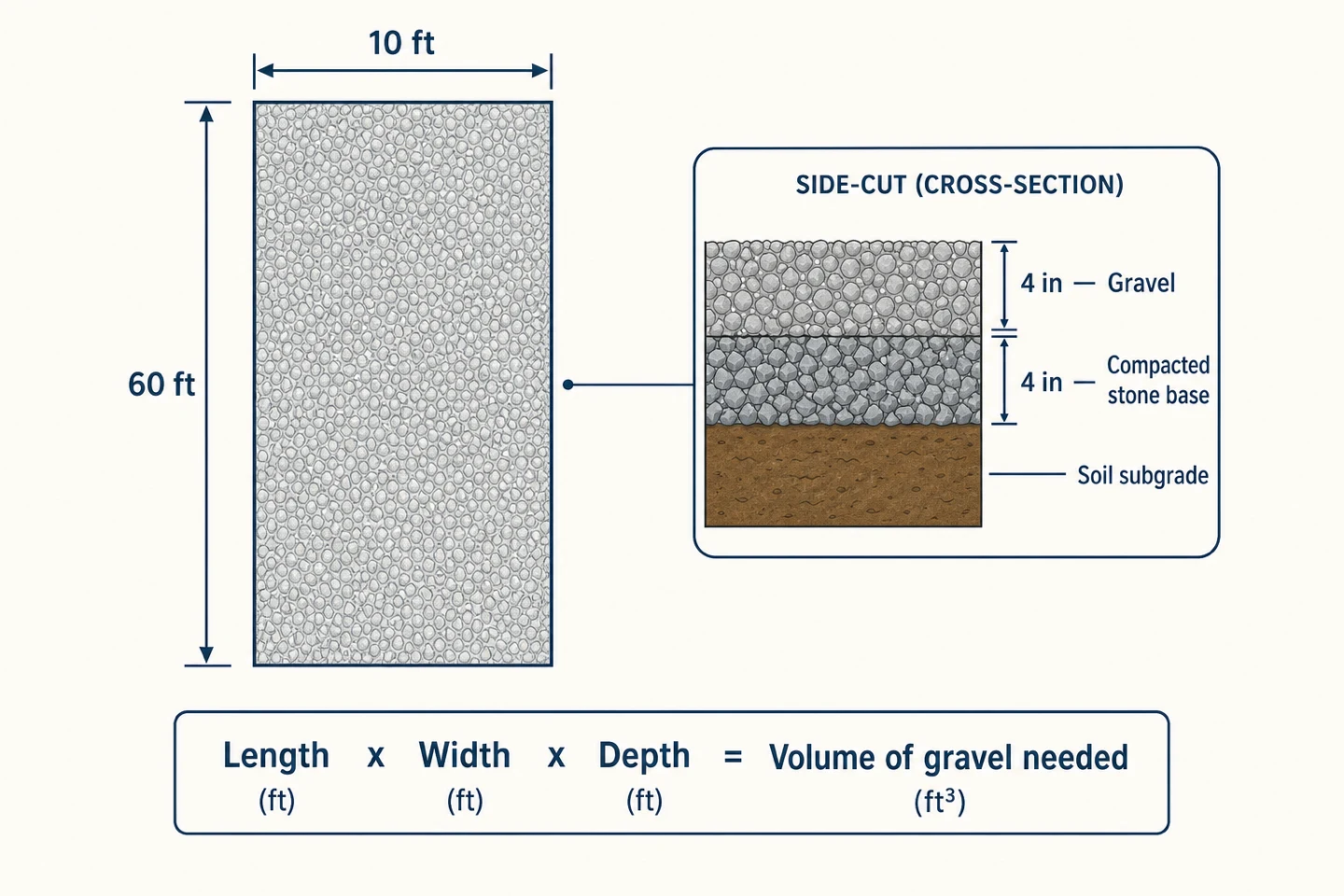
- Width: 10 ft
- Length: 20 yd * 3 ft/yd = 60 ft
- Depth: 6 in * 0.0277778 ft/in = 0.166667 ft
Step 2: Calculate the volume of the driveway
Next, the function calculates the volume of the driveway by multiplying the width, length, and depth together. The formula used is:Volume = width * length * depth
Using the converted measurements from Step 1, the volume can be calculated. For example, if the width is 10 ft, the length is 60 ft, and the depth is 0.166667 ft, the volume would be:Volume = 10 ft * 60 ft * 0.166667 ft = 100 ft³
Step 3: Calculate the cost of the gravel
To estimate the cost of the gravel, the function multiplies the volume of the driveway by the price per cubic yard of the gravel. The formula used is:Cost = volume * price
For example, if the price per cubic yard is $50, and the volume of the driveway is 100 ft³, the cost would be:Cost = 100 ft³ * $50/ft³ = $5000
Summary and Example
In summary, the function takes the user-provided dimensions of the driveway, converts them to a consistent unit of measurement, calculates the volume of the driveway, and then estimates the cost of the gravel based on the volume and price per cubic yard. Suppose a user enters the following dimensions and price:- Width: 12 feet (ft)
- Length: 25 yards (yd)
- Depth: 4 inches (in)
- Price per cubic yard: $60
- Width: 12 ft
- Length: 25 yd * 3 ft/yd = 75 ft
- Depth: 4 in * 0.0277778 ft/in = 0.111111 ft
Volume = 12 ft * 75 ft * 0.111111 ft = 100 ft³
Step 3: Calculate the cost of the gravel:Cost = 100 ft³ * $60/ft³ = $6000
Therefore, for these dimensions and price, the function would calculate that 100 cubic feet of gravel is needed, and it would cost $6000.What type of gravel is best for a driveway?
When it comes to choosing gravel for a driveway, there are a few options to consider. The best type of gravel for a driveway depends on various factors such as climate, budget, and personal preference. Here are some common types of gravel used for driveways:
- Crushed Stone: This is a popular choice for driveways as it provides good drainage and a stable surface. It comes in different sizes and shapes, ranging from crushed limestone to granite or gravel.
- Pea Gravel: Pea gravel consists of small, rounded stones that are smooth and often used for decorative purposes. While it may not be the best option for heavy traffic areas, it can work well for driveways with lighter use.
- Gravel with Fines: Gravel with fines, also known as crusher run, is a mixture of small crushed stones and stone dust. It compacts well and creates a solid base for driveways.
- Gravel with Hardener: Some gravel driveways may benefit from the use of a gravel hardener, which helps to bind the stones together and reduce shifting.
Ultimately, the best gravel for your driveway will depend on your specific needs and preferences. It's a good idea to consult with a local supplier or contractor who can provide guidance based on your location and requirements.
How much does it cost to install a gravel driveway?
The cost of installing a gravel driveway can vary depending on various factors such as the size of the driveway, the type and quality of gravel used, and the location. On average, the cost can range from $1,500 to $3,000 for a standard-sized driveway.
It's important to note that this is just an estimate, and the actual cost may be higher or lower based on individual circumstances. It's recommended to get quotes from multiple contractors in your area to get a more accurate idea of the cost.
How often does a gravel driveway need maintenance?
Gravel driveways typically require regular maintenance to keep them in good condition. The frequency of maintenance depends on various factors such as the amount of traffic, weather conditions, and the quality of the gravel used. Generally, it is recommended to inspect and perform maintenance tasks on a gravel driveway at least once a year.
Some common maintenance tasks for gravel driveways include:
- Removing weeds and vegetation that may grow through the gravel
- Repairing potholes or areas with significant erosion
- Adding additional gravel to replenish any lost due to erosion or displacement
- Raking or leveling the gravel to ensure an even surface
- Compacting the gravel to prevent it from shifting or becoming loose
Regular maintenance not only helps to keep the driveway looking neat and well-maintained but also extends its lifespan. It is important to address any issues promptly to prevent further damage and costly repairs.
How long does a gravel driveway last?
A gravel driveway can last anywhere from 10 to 100 years, depending on various factors such as the quality of the gravel, the amount of traffic it receives, and how well it is maintained. With proper installation and regular maintenance, a gravel driveway can provide a durable and functional surface for many years.
What are the pros and cons of having a gravel driveway?
Pros and Cons of Having a Gravel Driveway
Gravel driveways have both advantages and disadvantages. Here are some pros and cons to consider:
Pros:
- Cost-effective: Gravel is generally cheaper to install and maintain compared to other driveway materials.
- Easy installation: Gravel driveways can be installed quickly and easily, especially if the area is already leveled.
- Good drainage: Gravel allows water to drain through, preventing puddles and potential damage caused by water accumulation.
- Low maintenance: Gravel driveways require minimal maintenance, with occasional raking and replenishing of gravel.
- Customizable appearance: Gravel comes in various colors and sizes, allowing you to create a unique and aesthetically pleasing driveway.
Cons:
- Regular maintenance: While gravel driveways are low maintenance, they still require periodic raking and adding more gravel to keep the surface even.
- Dust and dirt: Gravel driveways can generate dust and dirt, especially in dry weather conditions, which may require regular cleaning.
- Less traction: Compared to paved surfaces, gravel driveways may offer less traction, especially during rainy or snowy weather.
- Weed growth: Weeds can sometimes grow through the gravel, requiring occasional weed control measures.
- Potential displacement: Gravel can shift and become uneven over time, requiring occasional leveling and regrading.
Recommended Resources
 Reviewed by
 Ergeon QA