Should You Pay a Fence Contractor Upfront?
Should you pay a fence contractor upfront? A small deposit is normal, paying in full is not. State caps and a safer schedule.
No, not in full. A modest deposit at signing is normal in the fence trade and several states cap how large it can be, but paying the whole price before a post is set leaves you with nothing to secure completion. The safe structure is a small deposit if the contract calls for one, no progress payment until materials are on site or posts are in, and the balance only after you have walked the finished fence against the contract. Ergeon's own process follows that shape: no deposit in California, a $150 deposit in some other states in line with local norms, and the balance due online after you sign off on the completed fence, with monthly financing available on qualifying projects. Here is how to read a payment schedule, what your state allows, and when a larger deposit is legitimate.
There are honest reasons and there are warning signs, and the size of the ask usually tells you which one you are looking at. A small deposit does three legitimate things: it confirms you are serious so the contractor can hold a crew date, it covers scheduling and permit legwork, and it offsets the risk of a homeowner canceling after materials are ordered. Special-order items such as a specific vinyl color, ornamental aluminum, or custom gates can justify a larger deposit because the supplier will not take them back.
Anything beyond that is the contractor asking you to finance their business. A request for half or more before work begins usually means cash flow problems, meaning your deposit pays for the previous customer's lumber. A request for full payment upfront removes every incentive to finish your fence on time or at all. Fence work is priced by the linear foot: Ergeon's last 12 months of projects put most homeowners at about $22 to $56 per foot for wood and $36 to $68 for vinyl, and the national averages in Ergeon's wood fence costs and vinyl fence costs guides run higher still, so a 150 ft privacy fence can run several thousand dollars. That is too much to hand over on trust.
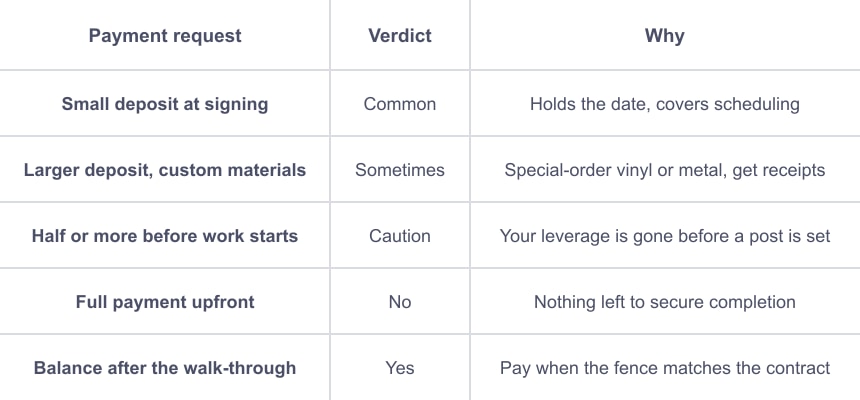
Roughly 10 percent at signing is common and defensible. Up to a third is the ceiling in several states that regulate home improvement contracts, and it should only get that high when special-order materials are involved and itemized. The rest should follow the work:
Never let the payment schedule run ahead of the work. If the crew has been paid for a fence that is 40 percent built, you are the one holding the risk.
Deposit rules vary by state, and some of the states where Ergeon works have specific caps. These are the ones homeowners ask about most:
Even where no cap exists, most state licensing boards publish consumer guides that say the same thing: keep deposits small and tie payments to progress. Separately, the federal Cooling-Off Rule gives you three business days to cancel a contract signed in your home for $25 or more, which is worth knowing if a door-to-door bid pushed you to sign fast. Check your own state's licensing board before you pay anything, and ask the contractor for their license number so you can confirm it is active.
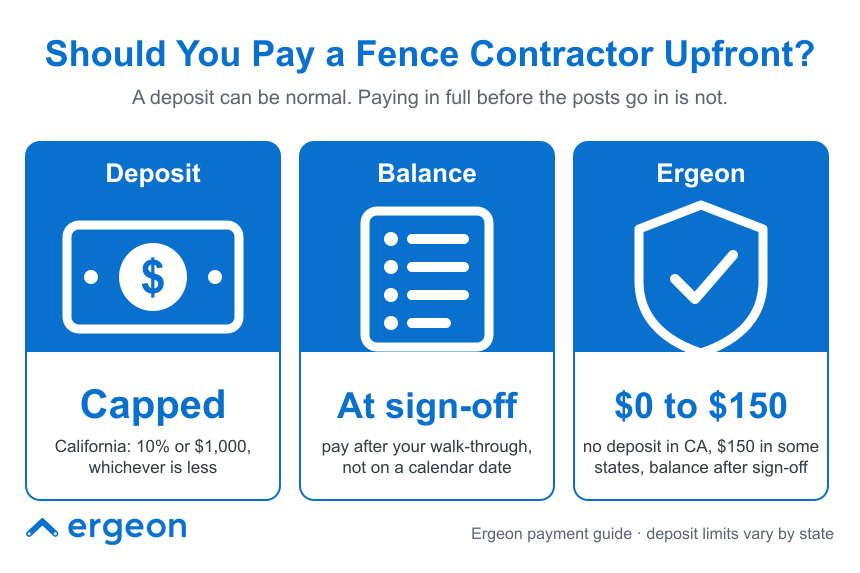
Ergeon's how it works flow is built so money follows the work. You get a quote on a live video call, review it, and approve it online. A project manager schedules the crew. Deposit practice varies by state and follows local market convention. In California, no deposit is required for residential fence projects. In some other states Ergeon collects a $150 deposit, in line with local norms. When the fence is done, you sign off, give feedback, and pay the balance online. The quote spells out the exact payment schedule, and digital payment means there is a receipt for every dollar. If you would rather spread the cost, you can prequalify for monthly financing on qualifying outdoor projects before the install date.
That structure is backed by the things a homeowner would otherwise use a large deposit to protect: Ergeon is licensed, bonded, and insured in every market it serves, more than 20 states, with license numbers published in the footer of every ergeon.com page, and it holds a 4.81 out of 5 rating across more than 22,000 verified reviews. The warranty, described in Ergeon's homepage FAQ, covers craftsmanship (fit, finish, fastening, and alignment) plus manufacturer material defects, backed by a warranty reserve, with the specific terms attached to your quote.
The payment method matters almost as much as the schedule. A few habits that protect you regardless of who you hire:
If a contractor pushes back on any of these, that is your answer. For shared fences where a neighbor is paying half, Ergeon's good neighbor fence guide covers how to split the payment without one household fronting the whole job.
Almost never. The only defensible exceptions are very small jobs, such as a single gate repair priced under a few hundred dollars, or a contractor you have used repeatedly and trust completely. Even then, paying at completion costs you nothing and protects you from a no-show. A legitimate contractor with steady work does not need your full payment to buy lumber. If someone insists, get another bid. Ergeon quotes are free, delivered on a video call without a site visit, and approved online with no obligation, which makes a second opinion easy.
Yes, especially if the contract does not attach a drawing. A deposit locks you into a scope, and if that scope puts the fence a foot onto a neighbor's lot or inside a city setback, the money you save on a fair payment schedule gets spent on rework. A scaled site plan shows the parcel boundary, the house footprint, and the proposed fence line, so you and the contractor agree on the same location before any payment changes hands. A certified site plan from a licensed surveyor often runs $1,000 or more and is only needed when a city specifically asks for one. For most fence contracts and permit applications, Ergeon can generate a permit-ready, GIS-based site plan in about 15 minutes for $29, the same GIS site plan Ergeon uses as the base for its own permit filings, with your fence layout and any other documents the city requires added on top.
Should you pay a fence contractor upfront?
Not in full. A small deposit at signing is normal, a progress payment should track a visible milestone, and the balance is due after your walk-through. Ergeon collects no deposit in California and a $150 deposit in some other states, with the balance due online after you sign off.
How much deposit should a fence contractor ask for?
About 10 percent is common. Several states cap it: California at 10 percent or $1,000, whichever is less, and Maryland, Massachusetts, and Pennsylvania at one third of the price, with allowances for special-order materials.
Is it normal for a contractor to ask for 50 percent upfront?
It happens, but it should give you pause unless the job is mostly special-order materials and the contract itemizes them. Half before any work usually means you are financing the contractor's cash flow.
What if the contractor only takes cash?
Walk away. Cash-only payment leaves no record and often signals a contractor who is unlicensed, uninsured, or not reporting the work. Pay by card, check, or a documented digital transfer.
Does Ergeon require a deposit?
It depends on the state. In California, no deposit is required for residential fence projects. In some other states Ergeon collects a $150 deposit, in line with local norms. The balance is due online after your walk-through and sign-off, your quote lists the exact schedule, and monthly financing is available on qualifying projects.
Get a free fence quote - Call 1-888-374-3661. Monthly-payment financing is available on qualifying projects.
 Local Guides
 Local Guides
 Local Guides


