Online Fence Company vs. Local Fence Contractor
Online fence company vs local fence contractor: quote speed, price, accuracy, licensing, payment, warranty and who wins when.
The real difference between an online fence company and a local fence contractor is the process, not the price. An online company like Ergeon measures your yard from satellite imagery, confirms the details on a live video call from your phone, and delivers an itemized quote in about a day that you approve online, with little or nothing due until the fence is finished. A local contractor sends an estimator, measures in person, and emails a bid days later, with payment terms that vary from one company to the next. A comparable fence from a well-run local contractor generally lands in a similar range; Ergeon's last 12 months of projects put most homeowners at about $22 to $56 per foot for wood and $36 to $68 for vinyl, against national averages of roughly $44 to $67 and $44 to $70. Where the two diverge is speed, transparency, how you compare options, and how you verify who you are hiring. This guide compares them factor by factor and tells you honestly when a local contractor is the better call.
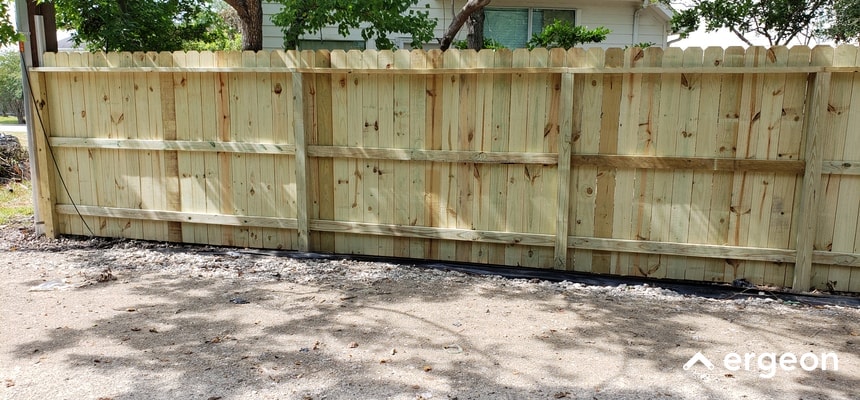

A quick definition first. An online fence company is a licensed installer that runs the quoting, approval, and payment process through software: a fence calculator for an instant estimate, satellite measurement, a video walk-through instead of a sales visit, and an online account for the contract, schedule, and payment. Crews still build the fence in person. A local fence contractor is a company in your area that quotes by site visit and manages the job by phone, email, and paper. Some local contractors are excellent, some are a truck and a phone number, and the range is wider than it is online.
The factors that matter, in the order homeowners usually feel them:
This is where the two models differ most, and it is worth walking through both.
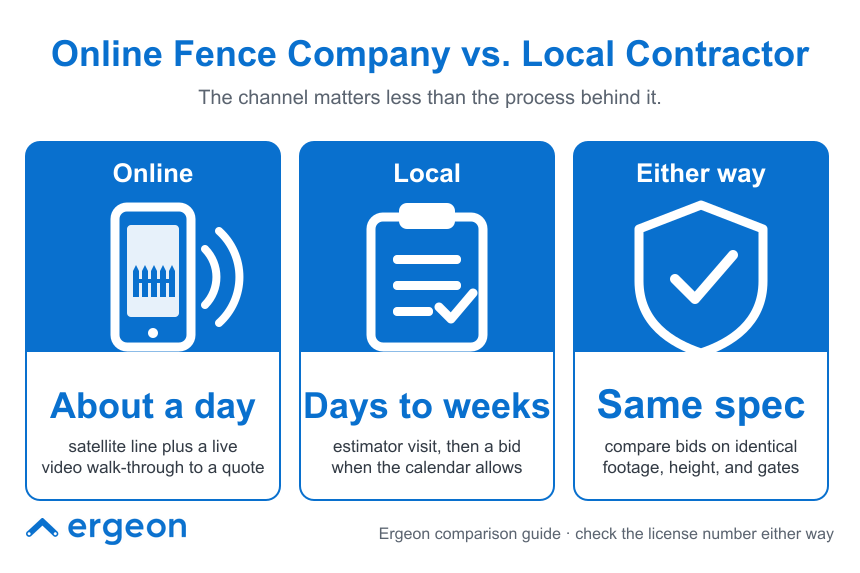
Online. You draw your fence line on a satellite map and see an instant estimate before you talk to anyone. When you request a full quote, Ergeon calls within 24 hours to book a video call. You join from your phone, walk the yard with a specialist, and point the camera at slope, gates, access points, and whatever has to come out. The specialist models the fence on screen during the call, and most customers have a quote the same day or the next. Want to see a 6 foot board on board next to a 5 foot nail-up? Both versions come from the same call. Edits after the call typically come back within 24 hours, and you approve online.
Local. You call or fill out a form, and an estimator schedules a visit, often several days out. They measure with a wheel or tape, look at the site, and take notes. The bid arrives by email a few days later, sometimes as a single number. If you want a different height or style, you ask, and either the estimator re-prices from notes or comes back out. Approval is a signature on a PDF or a paper contract.
Neither process is inherently more accurate. A careful estimator on site and a careful specialist on video both catch the slope that adds post length and the gate that needs a wider opening. The online process wins on time and on the ability to compare, and it leaves a written trail of every option and change. The local process wins if your yard has conditions a camera cannot show well, such as dense overgrowth along the line or unclear boundary markers, though a good video call will flag those and schedule a site check. Ergeon supports in-person estimates in those cases.
What makes the online version more than satellite plus a phone call is the engine behind it. Ergeon's quoting tool is a CAD model in which every fence line carries real materials, per-component quantities, labor, and live pricing; the public 3D calculator is a front end on that same engine. That is why the quote is itemized down to the gate and why a second version costs minutes rather than a second visit.
Not by default, and be skeptical of anyone who says otherwise in either direction. The installed price of a fence is driven by footage, height, style, material, gate count, removal, and site conditions like slope and rock. Those inputs are the same no matter who quotes them. Ergeon's own project data shows most homeowners paying $22 to $56 per foot for wood and $36 to $68 for vinyl over the last 12 months, below the national averages of roughly $44 to $67 and $44 to $70 reported in its wood fence costs and vinyl fence costs guides, and a well-run local contractor generally lands somewhere in that territory.
Where the real cost differences show up:
The fair comparison is one online quote and one or two local bids on the identical spec: same footage, same height, same material and style, same gate count, removal included on every bid or on none.
Accountability comes from the company, not the channel. The things to check are the same for both:
A licensed, reviewed, warranty-backed online company is more accountable than a local crew with none of those. A long-established local contractor with all of them is more accountable than an online lead form that resells your address to whoever pays for it. Sort by the checklist, not the label.
Honest cases where local wins:
Line them up on the same page and check five things: identical footage and height, identical material and style (not "wood" but "6 foot cedar board on board"), the same gate count and widths, removal and haul-away included or excluded on both, and the warranty document attached to each. Then compare license numbers on the state board and payment terms. If a bid cannot be itemized to that level, that is the answer about that bid. If the fence sits on a shared line, Ergeon's good neighbor fence guide covers splitting the cost, and if your city requires a permit, Ergeon can generate a permit-ready, GIS-based site plan in about 15 minutes for $29, with one free revision, so both bidders are working from the same drawing.
Is an online fence company better than a local fence contractor?
Neither is better by default. Online companies win on speed, transparency, and the ability to compare options; local specialty contractors often win on custom iron, masonry, and unusual sites. Judge either one by license, reviews at scale, written warranty, and payment terms.
Are online fence quotes as accurate as in-person estimates?
Yes, when the company confirms satellite measurements on a live video walk-through and itemizes the quote. Slope, gates, access, and removal are all visible on camera, and anything unclear gets a site check before the price is final.
Is it cheaper to use an online fence company?
Not automatically. Installed prices for the same fence land in the same range either way. The savings from an online quote come from seeing the itemized price and removing what you do not need, and from written change orders that prevent surprise invoices.
Do online fence companies use their own crews?
Ergeon is licensed, bonded, and insured in every market it serves, and its state license numbers are listed in the footer of every page. The work is backed by Ergeon's craftsmanship warranty and a warranty reserve fund, and a project manager is your single point of contact from approval through sign-off.
How do I check whether a fence company is licensed?
Find the license number on the website or contract and search it on your state contractor board. Name, status, and classification should match. Ergeon lists its state numbers in the footer of every page.
Get a free fence quote - Call 1-888-374-3661. Monthly-payment financing is available on qualifying projects.
 Local Guides
 Local Guides
 Local Guides


