How Much Should a Fence Deposit Be?
How much should a fence deposit be? About 10% or less is normal; state caps run from $1,000 to one third. Ergeon's own terms.
A fence deposit should be small. Ten percent of the contract price or less is the norm in the fence trade, several states cap it by law, and the only legitimate reason for a larger deposit is special-order material the supplier will not take back. On a typical $6,000 privacy fence, that means $0 to $600 at signing, not $3,000. California caps a home improvement down payment at 10 percent or $1,000, whichever is less. Maryland, Massachusetts, and Pennsylvania cap it at one third of the price, with allowances for special-order items. Ergeon's own practice follows local convention: no deposit in California, a $150 deposit in some other states, and the balance due online after you walk the finished fence and sign off. Here is how to size a deposit, what your state allows, how to tell a fair ask from a warning sign, and what the rest of the payment schedule should look like.
Around 10 percent, and often less. A deposit does three legitimate jobs: it shows the contractor you are serious so they can hold a crew date, it covers permit legwork and scheduling, and it offsets the risk that you cancel after materials are ordered. None of those jobs needs a large check. A contractor with steady work and a supplier account does not need your money to buy lumber for your fence.
The size of the ask tells you something about the business. Ten percent or less is a contractor protecting a crew date. One third is the legal ceiling in several states and should only show up when special-order materials are itemized. Half or more is a contractor using your deposit to pay for the previous customer's job. Full payment up front removes every incentive to finish your fence on time or at all.
Based on Ergeon's last 12 months of projects, most homeowners pay about $22 to $56 per linear foot installed for wood and $36 to $68 for vinyl, which puts a 150 ft privacy fence anywhere from the low thousands to around $10,000. National averages in Ergeon's wood fence costs and vinyl fence costs guides run roughly $44 to $67 and $44 to $70 per foot. At those totals, a 10 percent deposit is a few hundred dollars, and a one-third deposit is real money you are handing over before a post is set.
Fence work falls under home improvement contractor law in most states, and a handful set hard caps:
Most other states do not set a cap, but their licensing boards publish consumer guides that say the same thing: keep the deposit small and tie every later payment to visible progress. Separately, the federal Cooling-Off Rule gives you three business days to cancel a contract of $25 or more signed in your home, which matters if a door-to-door bid pushed you to sign fast.
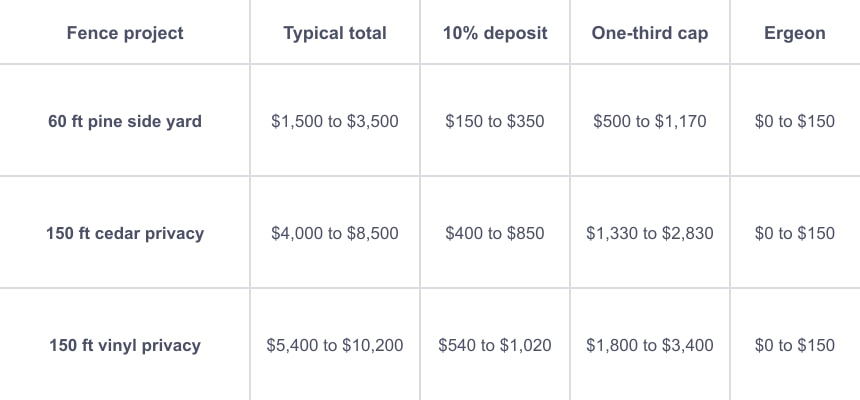
The totals use Ergeon's last-12-month pricing, and the 10 percent column is what a fair deposit looks like at each size. Two things stand out. First, even on the largest project a fair deposit is around $1,000, which is why California set its cap where it did. Second, the one-third column is the legal maximum in a few states, not a target. A contractor who asks for the maximum on a standard wood or vinyl fence with no special-order items is asking for more than the job justifies.
Special-order materials are the honest exception. A specific vinyl color the supplier has to produce, ornamental aluminum in a custom height, a powder-coated steel gate, or a double drive gate with automation hardware all have to be paid for before they ship, and the supplier will not take them back if you cancel. In those cases:
A larger deposit for a standard pressure-treated pine or cedar fence is not special-order. Those materials sit in every lumberyard.
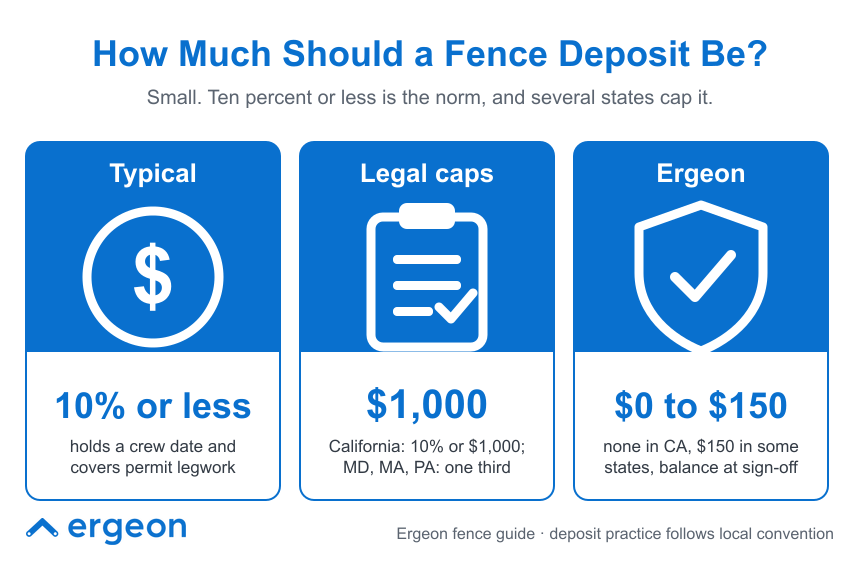
It depends on the state. Deposit practice varies by market and follows local convention. In California, no deposit is required for residential fence projects. In some other states Ergeon collects a $150 deposit, in line with local norms. The balance is due after your walk-through and sign-off, once the project is completed, and your quote states the exact schedule before you approve anything.
The rest of Ergeon's how it works process is built the same way. You get an itemized quote on a live video call, review it, and approve online. A project manager schedules the crew. When the fence is done, you walk the line, sign off, and pay the balance online, with monthly financing available on qualifying projects. Because the deposit is small or none, the things a homeowner would normally protect with a large deposit are covered other ways: Ergeon is licensed, bonded, and insured in every market it serves, more than 20 states, with license numbers published in the footer of every page, and it holds a 4.81 out of 5 rating across more than 22,000 verified reviews.
The deposit is only the first line. Ergeon's guide to how a fence payment schedule works covers each stage in detail, but the shape is simple:
If the schedule says "50 percent due on signing" or "balance due June 3," ask for it to be rewritten around work completed. For the full list of what belongs on paper, see what a fence contract should include.
Any one of these is a conversation. Two or more means get another bid. Ergeon's guide on whether to pay a fence contractor upfront covers how to pay safely once you have decided to go ahead.
Yes. A deposit locks you into a scope, and if that scope puts the fence a foot onto a neighbor's lot or inside a city setback, the money you saved on a fair deposit goes to rework. A scaled site plan shows the parcel boundary, the house footprint, and the proposed fence line, so you and the contractor are agreeing on the same drawing before any payment changes hands. A certified site plan from a licensed surveyor often runs $1,000 or more and is only needed when a city specifically asks for one or the boundary is disputed. For most fence contracts and permit applications, Ergeon can generate a permit-ready, GIS-based site plan in about 15 minutes for $29, the same GIS site plan Ergeon uses as the base for its own permit filings, with your fence layout and any other documents the city requires added on top.
How much should a fence deposit be?
About 10 percent of the contract price or less. California caps it at 10 percent or $1,000, whichever is less; Maryland, Massachusetts, and Pennsylvania cap it at one third with allowances for special-order materials. Ergeon collects no deposit in California and $150 in some other states.
Is a 50 percent deposit normal for a fence?
No. Half up front is above the legal cap in several states and above the norm everywhere. It usually means the contractor is financing their cash flow with your money. The exception is a job that is mostly special-order materials, itemized in the contract.
Can a fence contractor ask for the full price up front?
They can ask, and you should decline. Full payment before work starts leaves you nothing to secure completion, and in California it is illegal on a home improvement contract. Ergeon's balance is due after you sign off on the finished fence.
Does Ergeon require a deposit?
Not in California, where no deposit is required for residential fence projects. In some other states Ergeon collects a $150 deposit, in line with local norms. The balance is due online after your walk-through and sign-off, and monthly financing is available on qualifying projects.
Is a fence deposit refundable?
It depends on the contract's cancellation terms, so read them before you sign. Contracts signed in your home are covered by the federal three-day Cooling-Off Rule. Special-order materials you have paid for are generally yours to keep if you cancel.
Get a free fence quote - Call 1-888-374-3661. Monthly-payment financing is available on qualifying projects.
 Local Guides
 Local Guides
 Local Guides


