Fence Payment Schedule: How It Works
Fence payment schedule explained: capped deposit, milestone payment, and the balance after your walk-through. Samples inside.
A fence payment schedule is the part of the contract that says how much you pay, when, and what has to be true before each payment is due. A good one has three parts: a small deposit at signing if the contract calls for one, an optional milestone payment tied to visible progress such as materials on site or posts set, and the balance after you have walked the finished fence against the contract. The rule underneath all of it is that money follows the work. Ergeon's own schedule follows the same rule: no deposit in California, a $150 deposit in some other states in line with local norms, and the balance due online after you sign off on the completed fence, with monthly financing available on qualifying projects. Here is how each stage works, sample schedules for small and large fences, and how to read the fine print.
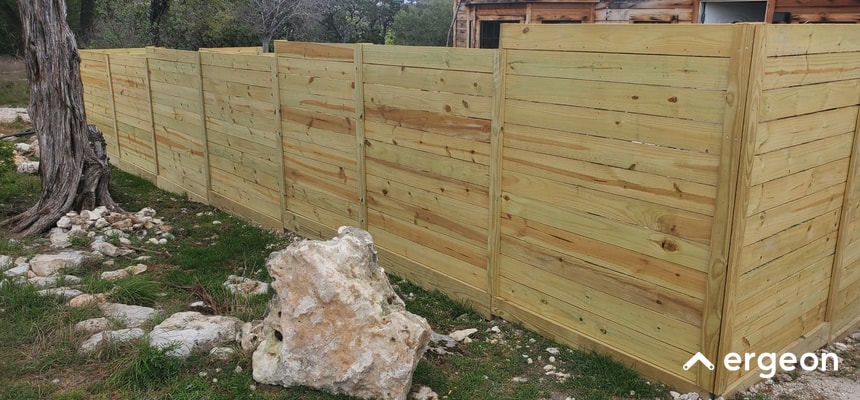
Most residential fence contracts break payment into two or three events. Each one should be defined by a condition you can see in the yard, not by a date on a calendar.
1. Deposit at signing. This confirms the job and lets the contractor hold a crew date and order materials. It should be small, refundable under the contract's cancellation terms, and paid by a method that leaves a record. Several states cap it: California limits home improvement down payments to 10 percent or $1,000, whichever is less, and Maryland, Massachusetts, and Pennsylvania cap deposits at one third of the price with allowances for special-order materials. Where there is no cap, around 10 percent is still the norm.
2. Milestone payment. On larger jobs, a payment when materials are delivered or when posts are set. It should never push your total paid ahead of the value of work completed. If you have paid 60 percent and the fence is 30 percent built, the schedule is upside down.
3. Final payment. Due after your walk-through, when footage, height, style, gate operation, and cleanup match the contract, and after you have any lien waivers the contract promised. This is the payment that secures completion, so it should be the largest.
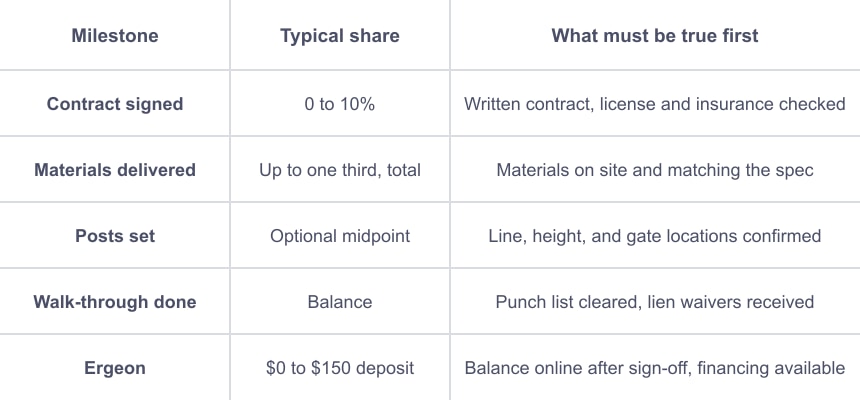
The shape of the schedule depends on the size of the job and whether anything is special-order. Three examples, using what most Ergeon customers paid over the last 12 months, about $22 to $56 per foot for wood and $36 to $68 for vinyl (the national averages in Ergeon's wood fence costs and vinyl fence costs guides run roughly $44 to $67 and $44 to $70)
In every version the final payment is the largest, and nothing is due on a date that arrives whether or not the work does.
The word to look for in the payment section is "upon," followed by something observable:
If the schedule says "50 percent due June 3" instead of "balance due upon final acceptance," ask for it to be rewritten. Ergeon's guide to what a fence contract should include covers the rest of the paperwork that surrounds the payment section.
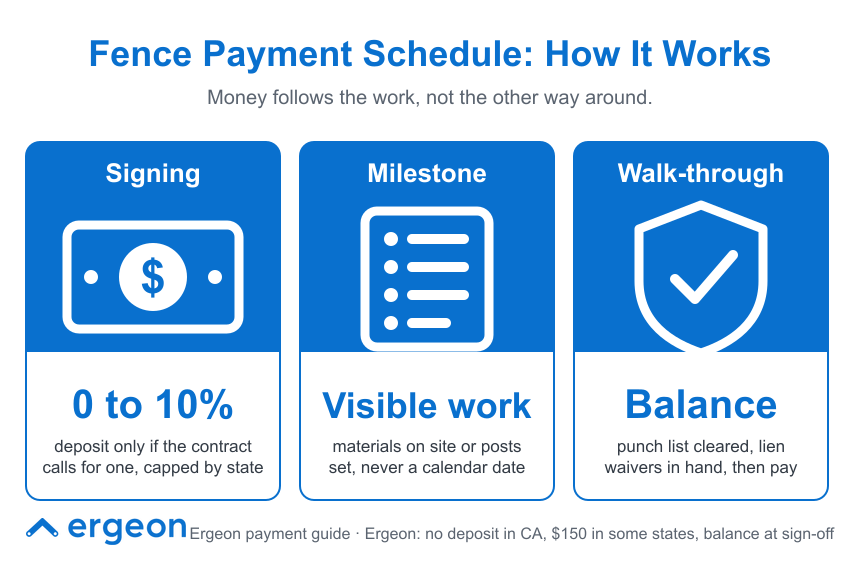
Ergeon's how it works flow removes most of the negotiation. You get a quote on a live video call, review it, and approve it online. A project manager schedules the crew and keeps you posted. Deposit practice varies by state and follows local market convention. In California, no deposit is required for residential fence projects. In some other states Ergeon collects a $150 deposit, in line with local norms. When the fence is done, you sign off, give feedback, and pay the balance online. Digital payment means every dollar has a receipt, and the quote states the exact schedule so there are no surprises on install day. If you would rather spread the cost, you can prequalify for monthly financing on qualifying outdoor projects before the crew arrives.
Because the deposit is small or none and the balance sits at the end, the things a homeowner normally protects with a large deposit are covered other ways: Ergeon is licensed, bonded, and insured in every market it serves, more than 20 states, with license numbers published in the footer of every ergeon.com page, and it holds a 4.81 out of 5 rating across more than 22,000 verified reviews. The warranty, described in Ergeon's homepage FAQ, covers craftsmanship (fit, finish, fastening, and alignment) plus manufacturer material defects, backed by a warranty reserve, with terms attached to your quote.
Change orders are where a clean schedule gets messy. If the crew hits rock, finds a buried footing, or you add a gate on install day, the price moves, and the payment schedule has to move with it. The contract should require your written approval of the new price before the extra work is done and should say which payment the change is added to. Usually that is the final payment, which keeps the milestone structure intact. Ergeon requotes typically come back within 24 hours, and because the fence is modeled on the video call with slope, access, and removal confirmed on camera, most changes are settled before the schedule is ever signed.
For shared fences, agree with the neighbor on who pays which portion before you sign. Ergeon's good neighbor fence guide covers how to split the cost, and the contract should reflect that split so one household is not fronting the whole job and chasing reimbursement.
Any one of these is a conversation. Two or more means get another bid.
Yes. The deposit locks you into a scope, so the fence location should be settled before the first payment. A scaled site plan shows the parcel boundary, the house footprint, and the proposed fence line, so you, the contractor, and any neighbor are agreeing on the same drawing before money moves. A certified site plan from a licensed surveyor often runs $1,000 or more and is only needed when a city specifically asks for one. For most fence contracts and permit applications, Ergeon can generate a permit-ready, GIS-based site plan in about 15 minutes for $29, the same GIS site plan Ergeon uses as the base for its own permit filings, with your fence layout and any other documents the city requires added on top.
How does a fence payment schedule work?
It ties each payment to a condition you can see: a small deposit at signing if the contract calls for one, an optional milestone when materials are on site or posts are set, and the balance after your walk-through and acceptance. Ergeon collects no deposit in California and a $150 deposit in some other states, with the balance due online after you sign off.
What is a normal deposit in a fence payment schedule?
About 10 percent or less. California caps home improvement deposits at 10 percent or $1,000, whichever is less; Maryland, Massachusetts, and Pennsylvania cap them at one third with allowances for special-order materials.
Should the final payment be the largest?
Yes. The final payment is what secures completion and the punch list. If most of the price has been paid before the walk-through, you have no leverage if something is wrong.
What is a holdback or retainage on a fence job?
A portion of the final payment, often 5 to 10 percent, kept until every punch list item is fixed. It is common on larger projects and worth writing into any contract that uses the phrase "substantial completion."
How does Ergeon's schedule handle changes?
Changes go through a requote, typically within 24 hours, that you approve online before the work is done. Because slope, gates, access, and removal are confirmed on the video call, most changes are settled before installation.
Get a free fence quote - Call 1-888-374-3661. Monthly-payment financing is available on qualifying projects.
 Local Guides
 Local Guides
 Local Guides


