Fence Contractor vs. Handyman: Who Should Build Your Fence?
Fence contractor vs handyman: who can legally build your fence, what each one costs, and when a handyman is the smarter call.
A handyman is the right call for a sagging gate, a few broken pickets, a post that needs resetting, or a fence that needs stain. A licensed fence contractor is the right call for a new fence or a full replacement, because that job runs into the thousands of dollars, usually needs posts set in concrete along a property line, often needs a permit, and should come with a written warranty. In several states the law draws the same line: California, for example, lets an unlicensed person take only jobs under $1,000 that need no permit and no helpers, and a 100 ft privacy fence clears that threshold on materials alone. Here is what each one can legally do, what each costs, where the risk sits, and how to check whoever you hire. Ergeon is a licensed, bonded, and insured fence contractor in more than 20 states, and the comparison below applies to any contractor you consider, including us.
The difference is scope, licensing, and what stands behind the work.
A fence contractor builds fences for a living. The company holds a contractor license where the state requires one (in California that is the C-13 Fencing classification), carries general liability and workers' compensation insurance, pulls permits, buys material at trade pricing, and runs crews that set dozens of posts a day. The work comes with a contract, an itemized price, and a craftsmanship warranty.
A handyman is a generalist who takes small jobs across many trades: hanging a door, patching drywall, fixing a gate latch, replacing a run of pickets. Most handymen work alone or with one helper, buy materials at retail, and work under a handyman exemption that caps the size of job they can legally take without a contractor license. Some are excellent craftspeople. The limit is not skill; it is scale, licensing, and liability.
A good rule of thumb: if the job can be finished in a day by one person without a permit, a handyman can usually do it. If it involves a property line, concrete, a permit, or a price with a comma in it, you want a contractor.
Repairs and maintenance are handyman territory, and hiring a full contractor for them is often overkill:
The question to ask is whether the repair changes the fence's footprint, height, or structure. If the answer is no, a handyman is a reasonable, cost-effective choice. Ask for proof of liability insurance anyway, since a ladder on your property is a ladder on your property.
The rules are set state by state, and a few matter most for fence work:
If you are not sure where your state lands, your state contractor licensing board publishes the rules, and most have a consumer guide on hiring. Ergeon lists its state license numbers in the footer of every page of its site, which is the standard any contractor should meet.
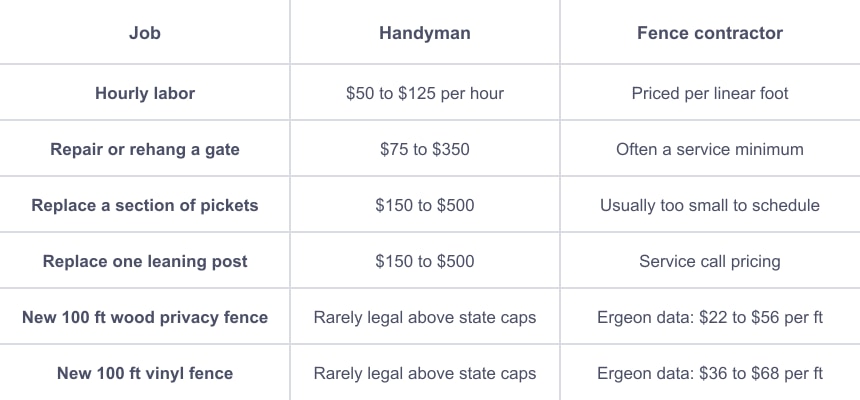
Handyman rates in 2026 cost guides from Angi and HomeAdvisor run about $50 to $125 per hour plus materials, with most charging a one-hour minimum, which is why a gate fix is cheap and a two-day fence build with one person is not. For a full fence, the per-foot math favors a contractor: crews buy at trade pricing, set posts in volume, and move at about 60 linear feet per day in clear site conditions. Based on Ergeon's last 12 months of projects, most homeowners pay about $22 to $56 per linear foot installed for wood and $36 to $68 for vinyl, against national averages of roughly $44 to $67 and $44 to $70 in Ergeon's wood fence costs and vinyl fence costs guides.
A handyman quoting a full fence at a tempting price is usually saving on one of three things: post depth and concrete, insurance, or the permit. All three show up later as your problem, not theirs.
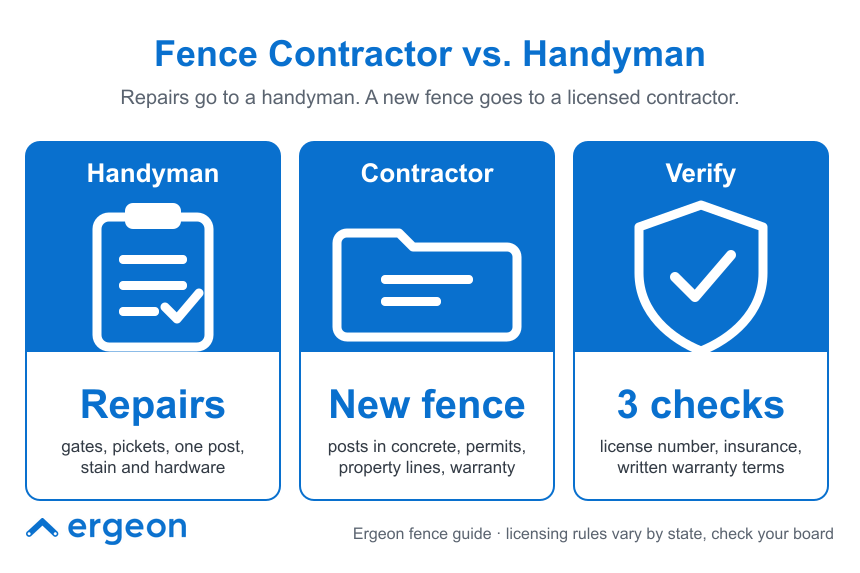
Whoever you hire, the checks are the same, and Ergeon's guide to what a fence contract should include covers the paperwork side:
Ergeon is a fence contractor, licensed, bonded, and insured in every market it serves, with license numbers published in the footer of every page. The quote happens without a sales visit: you draw the line on a satellite map for an instant estimate, a specialist confirms slope, gates, access, and removal on a live video call, and the itemized quote is built in a CAD model that carries real materials, quantities, labor, and live pricing. You approve online, builds are typically scheduled within about 20 days, and a project manager handles permits and scheduling. See how it works or call 1-888-374-3661. Quotes are free, and monthly financing is available on qualifying projects.
Yes, and this is true whether a handyman or a contractor does the work. A fence built on the wrong line is the one mistake neither can fix cheaply. A scaled site plan shows the parcel boundary, the house footprint, and the proposed fence, so the line is agreed before a post goes in. A certified site plan from a licensed surveyor often runs $1,000 or more and is only needed when a city specifically asks for one or a boundary is disputed. For most fence projects and permit applications, Ergeon can generate a permit-ready, GIS-based site plan in about 15 minutes for $29, the same GIS site plan Ergeon uses as the base for its own permit filings, with your fence layout and any other documents the city requires added on top.
Can a handyman build a fence?
For repairs, yes. For a new fence, it depends on your state. California caps unlicensed work at $1,000 with no permit and no helpers, Washington and New Jersey require registration for any paid work, and Texas has no state license for fencing. Even where it is legal, you give up insurance, warranty, and recourse.
Is a handyman cheaper than a fence contractor?
For small repairs, almost always. For a full fence, rarely by much once you compare like for like, and the savings usually come from skipped concrete, insurance, or permits. Most Ergeon customers pay about $22 to $56 per foot for wood and $36 to $68 for vinyl based on the last 12 months of projects.
Do I need a licensed contractor to replace an existing fence?
A full replacement is new construction in the eyes of most licensing boards and permit offices, so the same rules apply as for a new fence. Replacing a few pickets or a gate is a repair.
What license should a fence contractor have?
Whatever your state issues for fencing. In California it is the C-13 Fencing classification. Check the number on your state board and confirm the name matches the contract.
Does Ergeon do fence repairs?
Ergeon quotes new fences and full replacements. If you only need a gate rehung or a few pickets replaced, a local handyman is usually the faster, cheaper fit. When posts are failing along the whole line, that is a replacement, and Ergeon can quote it from a video call.
Get a free fence quote - Call 1-888-374-3661. Monthly-payment financing is available on qualifying projects.
 Local Guides
 Local Guides
 Local Guides


