Can You Negotiate a Fence Quote?
Can you negotiate a fence quote? Yes, on scope: height, style, material, gates, removal, shared lines. What moves your price.
Yes, but not the way most people expect. Fence pricing is built from linear feet, height, style, material, gates, and site work, and a contractor with a published rate has little room to shave the labor line without cutting corners you will not see until the posts lean. The real negotiation is over scope: what fence you are buying, how tall, in what material, with how many gates, and who hauls the old one away. Change those and the number moves honestly. Ergeon's quotes are itemized by material, style, linear feet, and add-ons, and Ergeon's last 12 months of projects put most homeowners at about $22 to $56 per foot for wood and $36 to $68 for vinyl, so every lever is visible on the quote and you can ask for several versions on one video call. Here is what moves a fence price, what does not, and how to compare bids without getting the cheapest fence instead of the best value.
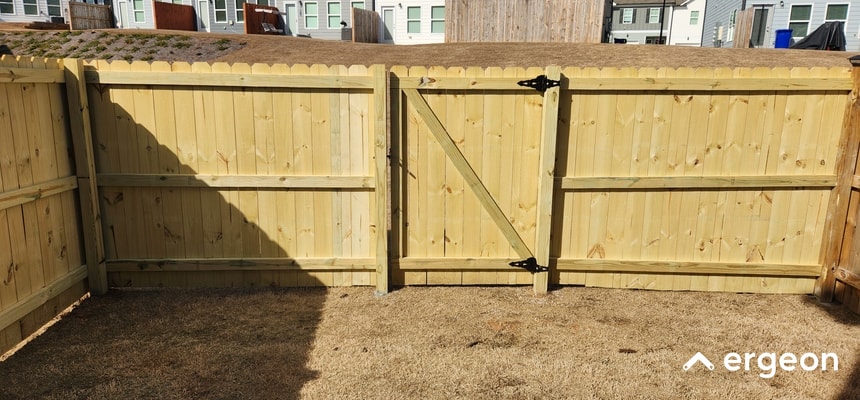
A residential fence quote is mostly materials plus a crew's time, and both are close to fixed for a given design. Lumber, vinyl, posts, concrete, and hardware cost what the supplier charges. Labor is a function of footage, terrain, and how many holes have to be dug. Ergeon crews install about 60 linear feet per day in clear site conditions, so a 150 ft fence is two to three crew-days regardless of how the conversation goes. The margin on top of that covers licensing, insurance, warranty reserves, and the office that schedules your install.
When a contractor knocks 15 percent off a lump-sum bid because you asked, one of three things happened: the original number was padded, the discount is coming out of materials or crew hours you cannot inspect, or the contractor is underbidding to win the job and will recover it on change orders. None of those is good for you. A quote that will not move on the rate but shows every line is usually the more trustworthy one.
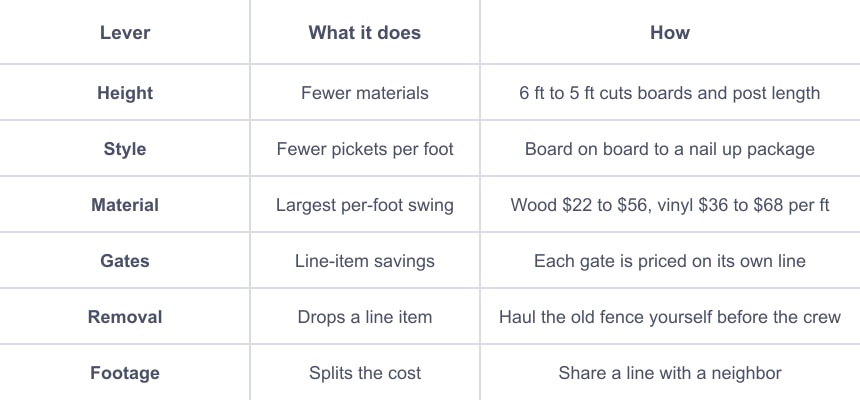
These are the levers worth pulling, roughly in order of how much they change the total:
Some line items look like savings and are actually the fence's lifespan:
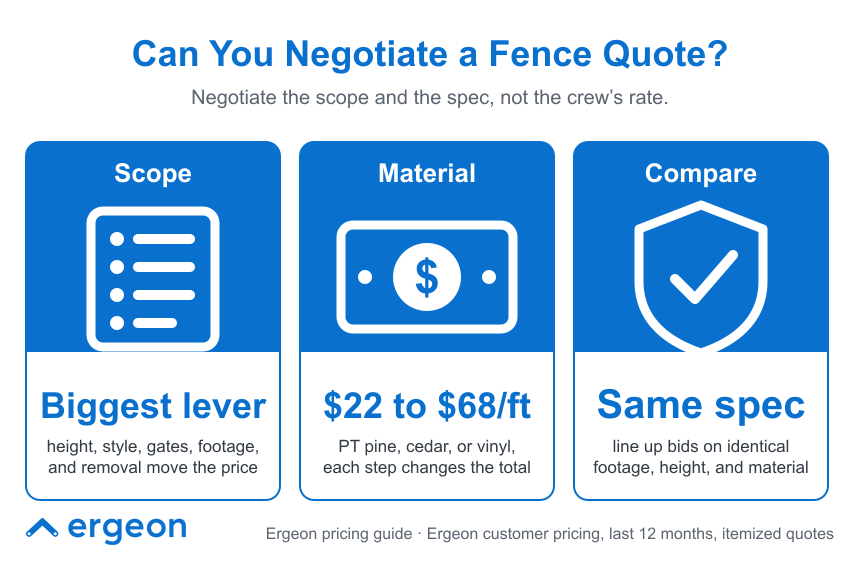
Most "negotiation" happens before you ever talk to a contractor, when you line bids up against each other. The trap is comparing a lump sum for "6 ft privacy fence" from one bidder against an itemized quote from another. To compare properly:
Ergeon's guide to what a fence contract should include covers the paperwork side of the comparison.
Ergeon's pricing is transparent and itemized, so the conversation is about the fence, not the rate. On the how it works video call, a specialist models your fence on screen while you watch and can generate several quote versions in one session: 6 ft next to 5 ft, cedar next to pressure-treated pine, one gate versus two, or a version that splits a shared line with your neighbor. You see how each choice changes the total before you commit to any of them. After the call, requotes typically come back within 24 hours. You approve online, and monthly financing is available on qualifying projects if spreading the cost matters more than trimming it.
That means the most effective way to lower an Ergeon quote is to arrive at the call knowing which trade-offs you are open to: a lower height, a simpler style, fewer gates, handling removal yourself, or a neighbor who will share a side.
Yes, because footage is the one variable every bid depends on, and a fence line that shifts a few feet changes every quote you have collected. A scaled site plan shows the parcel boundary, the house footprint, and the proposed fence, so every contractor is pricing the same line and any neighbor split is based on a drawing rather than a guess. A certified site plan from a licensed surveyor often runs $1,000 or more and is only needed when a city specifically asks for one. For quote comparisons and most permit applications, Ergeon can generate a permit-ready, GIS-based site plan in about 15 minutes for $29, the same GIS site plan Ergeon uses as the base for its own permit filings, with your fence layout and any other documents the city requires added on top.
Can you negotiate a fence quote?
Yes, on scope. Height, style, material, gate count, removal, and shared footage all change the price honestly. The labor rate on a well-built fence has little room to move, and a big discount on request usually means the bid was padded or something was cut.
What is the biggest lever on a fence price?
Material, then height. Pressure-treated pine at the low end of the $22 to $56 wood range versus vinyl at up to $68 per foot is the widest swing, and dropping from 6 ft to 5 ft reduces materials across the whole run.
Is it rude to ask a fence contractor for a lower price?
No, but ask for a different scope rather than a discount. "What would this cost at 5 ft with one gate?" gets a real answer. "Can you do better?" gets a padded bid trimmed or a corner cut.
Can I get multiple versions of an Ergeon quote?
Yes. The specialist can build several versions on one video call, such as different heights, materials, or gate counts, or a version that splits a shared line with a neighbor. Requotes after the call typically come back within 24 hours.
Should I take the cheapest fence bid?
Only if it matches the other bids on footage, height, material, post size, gate count, exclusions, license, insurance, and warranty. A bid far below Ergeon's range or the national average is usually missing one of those.
Get a free fence quote - Call 1-888-374-3661. Monthly-payment financing is available on qualifying projects.
 Local Guides
 Local Guides
 Local Guides


